Castles on Scottish lochs were built for control, not for postcards, but they ended up as some of the most photographed buildings in the country. The good news for anyone with a camera or a taste for history is that most of the famous ones sit within a short walk of a car park, and the light over a west coast loch can turn a grey ruin into a reason for a long drive. Here are eight that are genuinely reachable, with notes on how to get there, where to stand and when to go.
Eilean Donan Castle, Loch Duich
The one everybody knows. Eilean Donan sits on a small tidal island where three lochs meet — Duich, Long and Alsh — beside the village of Dornie on the A87, about twenty minutes from Kyle of Lochalsh.
Its origins go back to the thirteenth century, and it was a stronghold of the Mackenzies and then the Macraes. In 1719 a Jacobite garrison backed by Spanish soldiers was shelled by government warships, and the castle lay in ruins for nearly two centuries before John MacRae-Gilstrap rebuilt it between 1912 and 1932. The interior is open to visitors in season; check dates before travelling.
Parking is in the pay-and-display car park beside the visitor centre, signed from the village. There is also a roadside viewpoint further east on the A87 for the classic wide shot — keep clear of passing traffic and move on quickly, because the layby fills fast in summer and the road carries a steady stream of coaches heading for Skye.
Morning is the better bet. The light comes across the loch from the east, the coaches have not yet arrived, and if the tide is low you can see the causeway and the rock the castle was built to command. Cross the footbridge for the close view, but save some time for the far shore: a few hundred metres back along the road gives you the whole island, the bridge and a slice of Loch Duich in one frame, which is the version you have seen on shortbread tins and will almost certainly want to take home.
Urquhart Castle, Loch Ness
Urquhart is the great broken tooth of the Highlands, a shattered tower and a curtain wall on a promontory on the south-west shore of Loch Ness, about two miles east of Drumnadrochit on the A82 between Inverness and Fort William.
It was one of the largest medieval castles in Scotland. Held by the Durwards, then the Comyns, then the Grants from the early sixteenth century, it was fought over repeatedly — sacked by the MacDonalds in 1545 — and finally blown up by government troops in 1692 to stop the Jacobites using it. Nobody rebuilt it, which is precisely why it looks the way it does.
The visitor centre has a car park, a film and a cafe, and a footpath leads downhill to the ruin. It is a steep walk back up, and in season a shuttle buggy runs for those who would rather not. The best photographs come from the shore path below the walls in late afternoon, when the sun drops behind you and the loch goes silver, or from the layby on the A82 above for the long view along the water. Bring midge repellent for summer evenings — this is damp, sheltered woodland, and the insects know it.
Kilchurn Castle, Loch Awe
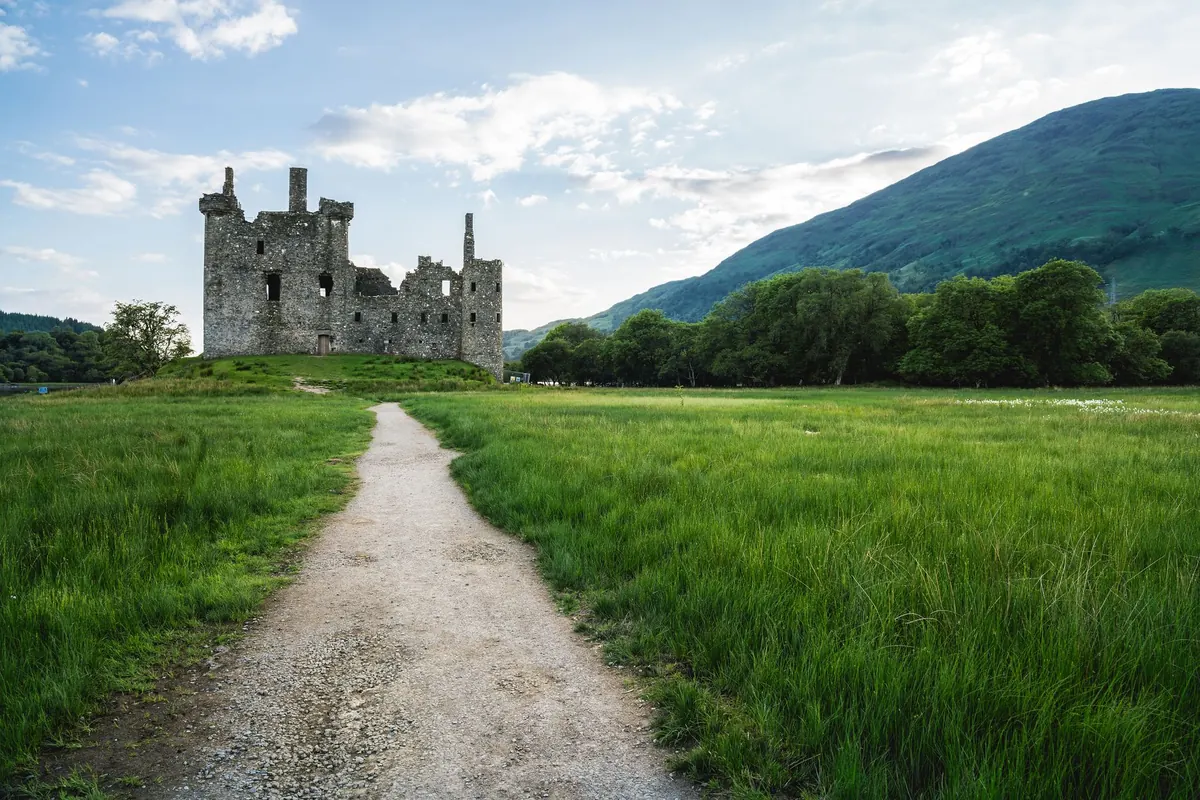
Kilchurn stands at the north-east end of Loch Awe near Dalmally, off the A85 between Tyndrum and Oban, and it may be the most quietly dramatic ruin in Scotland. Built around 1450 by Sir Colin Campbell of Glenorchy, extended in the 1690s, it was abandoned after a lightning strike in 1760 and left to the weather, with Ben Cruachan rising behind it.
Access is on foot. Park at the signed car park near Lochawe and follow the path to the peninsula — roughly twenty minutes each way, level but often muddy, and prone to flooding after heavy rain, so check conditions rather than assuming. Entry to the castle itself is free and managed by Historic Environment Scotland; the tower is occasionally closed for safety works.
The famous shot is from across the water or from the roadside on the far side of the loch, with the mountain looming behind and the ruin reflected when the wind drops. Early morning in autumn gives you mist on the water and almost nobody else on the path, which is about as good as Scottish photography gets.
Castle Stalker, Loch Laich
Castle Stalker sits on a tidal islet in Loch Laich, an inlet off Loch Linnhe near Portnacroish in Appin, just off the A828 between Oban and Ballachulish. It is a fifteenth-century keep, the one-time hunting seat of the Stewarts of Appin — the name comes from stalcaire, a hunter or falconer — and it starred as Castle Aaaaarrrrrrggghhh in Monty Python and the Holy Grail.
It is private, and only opens for a handful of days each year, so most visitors photograph it rather than tour it. That is no hardship: the view from the shore beside the Jubilee Bridge, a short walk from the layby on the A828, gives you the tower on its rock with the hills of Kingairloch behind, and at high tide it appears to float.
Check a tide table before you go. At low water you can see the islet for what it is; at high water you get the picture everybody wants. Either way, do not attempt to wade out — the currents in the narrows move quickly and the ground is unreliable.
Ardvreck Castle, Loch Assynt
Ardvreck is the wild one, a ragged tower on the shore of Loch Assynt in Sutherland, on the A837 east of Lochinver near Inchnadamph. It was built by the MacLeods of Assynt in the late sixteenth century, and in 1650 the Marquess of Montrose was held here after his defeat at Carbisdale before being taken south to execution.
The Mackenzies later took the estate and built Calda House nearby, now also a ruin, and the two together make a fine short walk. This is genuinely remote country: single-track road, passing places, few facilities, and a long drive from anywhere. Fill the tank in Lochinver or Ullapool and do not rely on your phone.
The reward is space. On a clear evening the ruin, the loch and the bulk of Quinag behind it give you a photograph with no crowds, no signage and no queue. It is also exposed to the weather, so a windproof layer is not optional.
Dunvegan Castle, Loch Dunvegan
Dunvegan is the odd one out, because it is not a ruin at all. On the west coast of Skye, about twenty-five miles from Portree, it has been the seat of the MacLeods for more than eight hundred years and claims to be the oldest continuously inhabited castle in Scotland.
Inside are the Fairy Flag, the Dunvegan Cup and Sir Rory Mor's Horn; outside are walled gardens and small boats that run out to the seal colony on the loch. There is an entry charge and the car park gets busy in July and August, so arrive early or late in the day.
For photography, head down to the shore below the castle rather than shooting from the car park. The building sits low against the water, and from the loch side you get the whole facade, the gardens and the hills of MacLeod's Tables beyond — a completely different prospect from the postcard view of the gate.
Loch Leven Castle, Loch Leven
Loch Leven Castle stands on an island in Loch Leven near Kinross, just off the M90, and it is the most historically loaded site on this list. Mary, Queen of Scots was imprisoned here in 1567 and 1568, forced to abdicate, and escaped by boat in May 1568 — one of the great set pieces of Scottish history.
You reach it by a small boat run by Historic Environment Scotland from the pier at Kinross, usually from April to October and weather dependent. It carries only a handful of passengers at a time, so turn up early in the day or be prepared to wait, and check the season before you build a trip around it.
Do not confuse this Loch Leven with the sea loch of the same name near Ballachulish. This one is lowland, wide and flat, with big skies and soft evening light, and the walk around the loch gives you long views of the island with the Lomond Hills behind — a gentler, calmer kind of picture than anything on the west coast.
Dunstaffnage Castle, near Loch Etive
Dunstaffnage guards the mouth of Loch Etive and the Firth of Lorn, a few miles north of Oban on the road towards Connel. It is one of the oldest stone castles in Scotland, built in the 1220s for Duncan MacDougall, and it was taken by Robert the Bruce in 1309 before passing to the Campbells in the fifteenth century.
There is a car park, an entry charge for the tower and walls, and a ruined chapel in the grounds. It is an easy half-day from Oban and pairs well with a stop at Connel Bridge to watch the Falls of Lora, where the tide races through the narrows twice a day and turns the water white.
Photograph it from the shore below the walls, where the castle sits on its rock above the water with the hills of Morvern across the firth. Late afternoon light here is exceptional, and the site is usually far quieter than its history deserves.
Photography Notes: Light, Tide and Weather
Scottish lochs are forgiving of bad technique and unforgiving of bad timing. A few habits will improve every picture you take.
- Chase the golden hour. An hour after sunrise and an hour before sunset will do more for a ruin than any filter. Midday light flattens stone and bleaches water.
- Watch the tide. Eilean Donan, Castle Stalker and Dunstaffnage all change character completely between high and low water. A tide table is as useful as a tripod.
- Embrace grey. Overcast skies suit ruins — soft, even light, no blown highlights. Save the blue-sky day for the wide views.
- Use the water as foreground. Get low, include the reflection, and let the castle sit in the corner of the frame rather than dead centre.
- Pack for four seasons. Waterproof jacket, spare cloth for the lens, and a plastic bag for the camera. Rain arrives sideways here.
- Know the drone rules. Many of these sites are scheduled monuments or sit near houses and livestock. Check before you launch.
The castle is not the photograph. The loch is. Put the water in the frame, wait for the wind to drop, and the ruin will do the rest.
Getting There and Getting Around
A car makes this list possible. Public transport reaches Oban, Fort William, Inverness, Kyle of Lochalsh and Portree, and there are buses along the A82, A85 and A87, but the smaller sites — Ardvreck, Castle Stalker, Kilchurn — really require your own wheels.
- Single-track roads: use the marked passing places, pull in for faster traffic, and never park in one.
- Fuel: fill up in the towns. Sutherland and Ardnamurchan have long gaps between pumps.
- Membership: a Historic Environment Scotland pass covers Urquhart, Kilchurn, Loch Leven and Dunstaffnage, and pays for itself in a week.
- Season: some sites close or run reduced hours from November to March. Always check before a long drive.
- Midges: worst on still, damp evenings from June to August. Repellent, long sleeves and a breeze are your friends.
A Workable Two-Day Route
- Start in Oban and drive north to Dunstaffnage, then on to Kilchurn on Loch Awe.
- Continue to Castle Stalker at Portnacroish for late afternoon and high tide.
- Overnight around Fort William or Ballachulish.
- Next morning, take the A82 north for Urquhart Castle and Loch Ness.
- Cut west to Eilean Donan at Dornie for the classic shot, then on to Skye and Dunvegan if you have a third day.
Leave Ardvreck and Loch Leven for another trip. Both are excellent, and both deserve more time than a rushed itinerary will give them.
Photo: Magic K / Pexels